Earthwool™ 1000° Pipe Insulation

Description
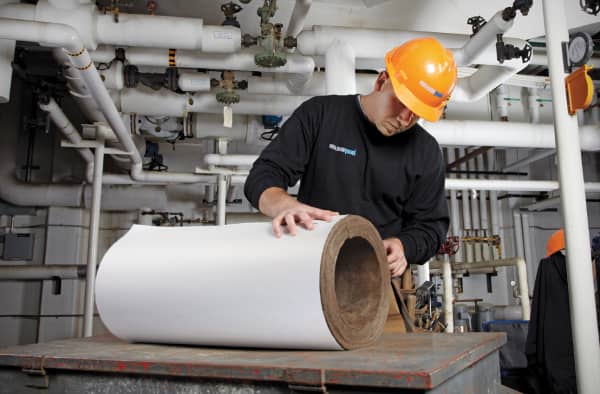
Knauf Insulation Earthwool™ 1000° Pipe
Insulation is a molded, heavy-density, one-piece insulation made
from inorganic glass fibers bonded with ECOSE®
Technology . It is produced in 3’ lengths with or without a
factory-applied jacket.
ASJ+ is the newest generation all-service jacket composed of
aluminum foil, reinforced with a glass scrim bonded to a kraft
paper interleaving with and outer film layer leaving no paper
exposed. A matching ASJ+ butt strip is furnished in the carton
for each section. The jacket is white, and the longitudinal lap of
the jacket has a self-sealing adhesive.
Earthwool
Earthwool is the new benchmark that
stands apart for its genuine sustainability, unsurpassed
performance and consistently high product quality.
ECOSE Technology
ECOSE Technology is a revolutionary binder based on rapidly
renewable bio-based materials rather than non-renewable
petroleum-based chemicals such as phenol, formaldehyde or acrylics.
ECOSE Technology reduces Knauf binder embodied energy and contains
no phenol, formaldehyde, acrylics or artificial colors found in
traditional fiber glass insulation.
Application
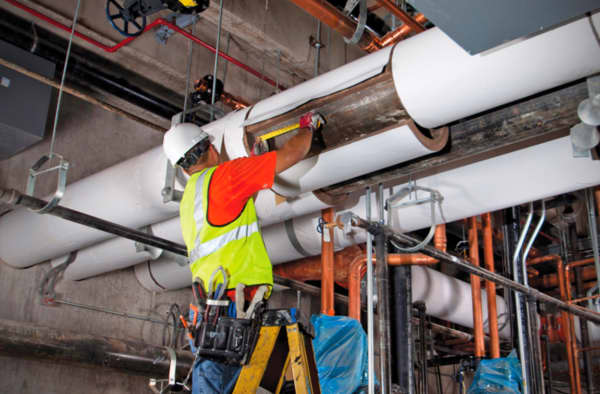
Earthwool 1000° Pipe Insulation is
used to insulate iron and copper piping in industrial applications
and in commercial and institutional buildings. Earthwool 1000° Pipe
Insulation is suitable for hot, cold, concealed and exposed piping
systems operating at temperatures from 0°F-1000°F (-18°C to 538°C).
Additional weather protection is needed outdoors.
Features and Benefits
Energy Conservation
- Offers excellent resistance to heat loss or gain, which saves
energy and lowers operating costs.
- A low thermal conductivity of .23 at 75°F (24°C).
Low-Cost Installation
Condensation Control
- Installed properly, the foil vapor retarder and
pressure-sensitive lap assure a positive vapor seal.
UL Classified
- All Earthwool 1000° Pipe Insulation, plain or jacketed,
meets the fire and smoke safety requirements of most federal,
state, and local building codes.
Easy Size Identification
- Pipe size, wall thickness, and Proto 25/50-Rated PVC fitting
cover size are printed in a repeat pattern along the longitudinal
lap.
- Easy identification at job site.
- Simplifies restocking.
ASJ+
- Professional finished appearance--dimple and wrinkle
resistant.
- Cleanable with a wet cloth and soapy water.
- Moisture resistant to intermittent, short duration liquid water
exposure, such as precipitation during construction phase.
- ASJ+ has substantially less degradation and discoloration when
exposed to UV.
- ASJ+ meets ASTM C1136 Type I, II, III, IV and meets VIII based
on the 75% better puncture resistance of ASJ+ (Mullen Burst).
- Excellent SSL adhesion.
Indoor Air Quality
- Certified for indoor air quality as a low emitting product by
The GREENGUARD Environmental Institute to both the GREENGUARD
Certification ProgramSM and the more stringent
GREENGUARD Children and SchoolsSM standard.
Sustainability
- Carbon negative: meaning Knauf insulation products used for
thermal insulating purposes recover the energy that it took to make
them in just hours or a few days, depending on the application.
Once installed, the product continues to save energy and reduce
carbon generation as long as it is in place.
Earthwool fiber glass insulation contains three primary
ingredients:
- Sand, one of the world’s most abundant and renewable
resources
- 45% post-consumer recycled bottle glass
- ECOSE Technology which reduces binder embodied energy by up to
70%
- It is anticipated to reduce its Global Warming Potential (GWP)
by approximatel 4%, a signifigant reduction in our carbon
footprint.
Specification Compliance
In U.S.:
In Canada:
- CAN/ULC S102-M88
- CCG F1-304 (plain only)
- CGSB 51-GP-9M
- CGSB 51-GP-52M (jacket)
Technical Data
Surface Burning Characteristics
- UL Classified.
- Does not exceed 25 Flame Spread, 50 Smoke Developed when tested
in accordance with ASTM E 84, CAN/ULC S102-M88, NFPA 255, and UL
723
Temperature Range (ASTM C 411)
- Pipe operating temperatures from 0°F to 1000°F (-18°C to 538°C)
at a recommended thickness of 6"
Water Vapor Permeance (ASTM E 96, Procedure A)
- Jacket has a water vapor permeance of .02 perms or less.
Corrosiveness (ASTM C 665)
Corrosion (ASTM C 1617)
- The corrosion rate in mils/yr will not exceed that of 1ppm
chloride solution.
Microbial Growth (ASTM C 1338)
- Does not promote microbial growth.
Water Vapor Sorption (ASTM C 1104)
- Less than 0.2% by volume.
Linear Shrinkage (ASTM C 356)
Technical Data - ASJ+
Surface Burning Characteristics
- UL Classified
- Does not exceed 25 Flame Spread, 50 Smoke Developed when tested
in accordance with ASTM E 84, CAN/ULC S 102-M88, NFPA 255 and UL
723.
Specification Compliance
- ASTM C 1136 (jackets); Type I, II, III, IV, VIII
Water Vapor Transmission
(ASTM E 96, Procedure A)
- Jacket has a water vapor permeance of .02 perms or less.
Water Vapor Sorption (ASTM C 1104)
- Less than 0.2% by volume.
Product Forms and Sizes
Produced in 3' (914 mm) sections:
- For iron pipe from 1/2" to 24"
nominal pipe size (15 mm to 610 mm).
- For copper tube from 5/8" to
61/8" (16 mm to 156 mm).
- Wall thicknesses from 1/2" to
6" (13 mm to 152 mm) in single layer (for most sizes).
- All insulation inner and outer diameters comply with ASTM C
585.
Packaging
- Four convenient carton sizes for easy ordering, inventory
tracking, and storage.
- Reinforced carton handles for strength and easy lifting.
- Bar-coded cartons for accurate shipments and tracking.
- Full product range stocked at distributors for fast
availability.
Precautions
Hot Pipe
- May be installed while the system is in operation, at all
temperatures up to 1000°F (538°C).
- Knauf Insulation recommends, for insulation thicknesses greater
than 6" (152 mm), the temperature must be increased from 500°F
(260°C) to maximum temperature at a rate not exceeding 100°F (56°C)
per hour.
- During initial heat-up to operating temperatures above 350°F
(177°C), a slight odor and some smoke may be given off as a portion
of the bonding material used in the insulation begins to undergo a
controlled decomposition.
- If natural convection is not adequate in confined areas, forced
ventilation should be provided in order to protect against any
harmful fumes and vapors that might be generated.
- Care must also be taken when using sealants, solvents, or
flammable adhesives during installation.
- A maximum of 6" (152 mm) wall thickness is
recommended.
Cold Pipe
- Use a continuous vapor retarder on piping operating below
ambient temperatures.
- Seal all joints, surfaces, seams, and fittings to prevent
condensation. Use of staples is not recommended.
- On below freezing applications, and in high abuse areas, the
ASJ jacket shall be protected with a PVC vapor retarding outer
jacket. In addition, exposed ends of insulation shall be sealed
with vapor barrier mastic installed per the mastic manufacturer's
instructions. Vapor seals at butt joints shall be applied at every
fourth pipe section joint and at each fitting to isolate any water
incursion.
- On chilled water systems operating in high humidity conditions,
it is recommended that the same guidelines be followed as listed
above for below freezing applications.
- Exterior hanger supports are recommended.
Outside Application
- Do not expose pipe insulation to weather. It must be covered
with appropriate jacketing, mastic, or vapor retardant
adhesives.
- All exposed surfaces must be protected. Proto®
Indoor/Outdoor PVC Jacketing is recommended. See Knauf Guide
Specifications for recommended PVC jacketing application
guidelines.
- Apply jacketing, mastics or vapor retardant adhesives per
manufacturer's instructions. For metallic jackets, factory-applied
and condensate retarders are recommended.
ASJ+SSL
- Keep adhesive and contact surfaces free from dirt and water,
and immediately seal once adhesive is exposed.
- Apply when ambient and insulation outer-surface temperatures
are between 20°F and 130°F (-6.7°C and 54°C).
- If stored below 20°F or above 130°F, allow insulation cartons
to stand within recommended temperature range for 24 hours prior to
application.
- Do not store product below -20°F (-29°C) or above 150°F
(66°C).
- When using Knauf Insulation's SSL closure system, make
sure the longitudinal and circumferential joints are properly
sealed by rubbing the closure firmly with a squeegee.
- When using Earthwool 1000° Pipe Insulation, the surface
temperature of the insulation should be between -20°F and 150°F
(-29°C and 66°C) during the life of the insulation.
Fittings and Hangers
- Use Proto 25/50-Rated (ASTM E 84) PVC Fitting Covers, applying
PVC fittings per Proto's Data Sheet.
- Fittings should be insulated to same thicknesss and R-value as
the adjoining insulation.
- Apply fittings per manufacturer's instructions.
- When required by specification, a hard insert of sufficient
length should be used to avoid compression of the insulation.
Additional Precautions
- Fiber glass may cause temporary skin irritation. Wear
long-sleeved, loose-fitting clothing, head covering, gloves, and
eye protection when handling and applying material.
- Wash with soap and warm water after handling.
- Wash work clothes separately and rinse washer.
- Use a disposable mask/respirator designed for nuisance-type
dusts where sensitivity to dust and airborne particles may cause
irritation to the nose or throat.
Application Guidelines
Storage
- Protect insulation from water damage or other abuse, welding
sparks and open flame.
- Cartons are not designed for outside storage.
Preparation
- Apply only on clean, dry surfaces.
- Pipe or vessel should be tested and released before insulation
is applied.
General Guidelines
- All sections should be firmly butted.
- Seal circumferential joint with a minimum 3" (76 mm) wide
butt-strip.
- Jackets, coatings, and adhesives should have a comparable
F.H.C. rating.
- ASJ+ may be painted. As with traditional ASJ, Knauf Insulation
does not encourage the painting of ASJ+ because the application of
any paint may change the surface burning characteristics and will
void the UL Classification and Knauf Insulation Limited Warranty.
Where painting is necessary, use common water, oil, or
solvent-based paints. All paints should be tested for compatibility
and adhesion before use.
- All piping should have continuous insulation.
- Position longitudinal lap downward to avoid dirt and moisture
infiltration.
- Do not expose pipe insulation to excessive vibration or
physical abuse.
- Faced insulation should not have a facing temperature above
150°F (66°C).
SSL Installation Instructions:
- To install SSL, first remove the kraft
release liner to expose adhesive.
- Carefully align the jacketing.
Starting in the center of the insulation section, begin initial SSL
tack using pressure in the direction of the overlap. Again,
starting in the center of the insulation section, with a plastic
squeegee begin to apply firm pressure to the bonded lap area
swiping from the center of the insulation section toward each
end.
- NOTE: After initial SSL
adhesive tack, it is critical that the closure is not re-opened and
repositioned on the facing. Doing so will weaken the adhesive
and diminish bond strength.
Butt Strip Installation
Instructions:
- To install Butt Strips, remove the
kraft release liner by separating the butt strip from the kraft
using the convenient, easy release kiss cut.
- Simply wrap the butt strip, centered
around the joint, and apply firm pressure with a squeegee.
-
NOTE: After initial Butt Strip adhesive tack,
it is critical that the closure is not re-opened and repositioned
on the facing. Doing so will weaken the adhesive and diminish
bond strength.
Recommended Thicknesses (ASHRAE
90.1-2010)
The minimum thicknesses are based on ASHRAE 90.1-2010 standards
and do not necessarily represent the Economic Thickness of
Insulation or the thickness required for proper condensation
control. Rather, they serve as minimum recommendations for
commercial applications. For recommended Economic Thickness,
install according to Knauf or NAIMA 3E Plus programs or as
specified.
Fiber Glass and Mold
Fiber glass insulation will not sustain mold growth. However,
mold can grow on almost any material when it becomes wet and
contaminated. Carefully inspect any insulation that has been
exposed to water. If it shows any sign of mold it must be
discarded. If the material is wet but shows no evidence of mold, it
should be dried rapidly and thoroughly. If it shows signs of facing
degradation from wetting, it should be replaced.
Notes
The chemical and physical properties of Knauf Insulation
Earthwool 1000° Pipe Insulation represent typical average values
determined in accordance with accepted test methods. The data is
subject to normal manufacturing variations. The data is supplied as
a technical service and is subject to change without notice.
References to numerical flame spread ratings are not intended to
reflect hazards presented by these or any other materials under
actual fire conditions. Check with your Knauf Insulation sales
representative to assure information is current.
Knauf Insulation Earthwool 1000° Pipe Insulation with ECOSE®
Technology products are certified for indoor air quality by The
GREENGUARD Environmental Institute™, to both the GREENGUARD
Certification ProgramSM and the more stringent
GREENGUARD For Children andSchoolSM Standard. www.
greenguard.org. The GREENGUARD INDOOR AIR QUALITY CERTIFIED Mark is
a registered certification mark used under license through the
GREENGUARD Environmental Institute.